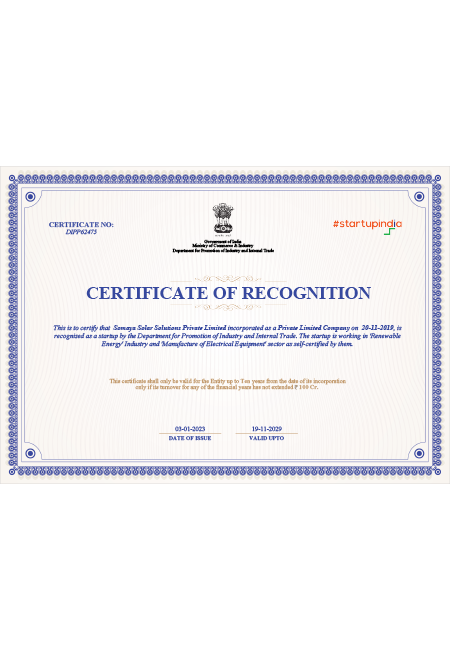
Somaya Solar Solutions Limited, a Ghaziabad-based solar company, installs rooftop solar systems in Saharanpur, Uttar Pradesh: for houses under PM Surya Ghar, and for shops, offices, schools, hospitals and factories. One team does the survey, supply, installation, metering and handover. A house in Uttar Pradesh can get up to ₹1,08,000 in subsidy for a 3 kW system: ₹78,000 from the centre and ₹30,000 from the state.
Somaya Solar as your installer in Saharanpur
Somaya Solar Solutions Limited is based in Ghaziabad, Uttar Pradesh, about 150 km from Saharanpur in a straight line. The company states on its site over 50 MW installed, 1,500+ customers, 7+ years of work and presence in 6+ states, and holds ISO 9001:2015, ISO 14001:2015 and ISO 45001:2018 certificates. See certifications and projects.
| Based in | Ghaziabad, Uttar Pradesh (C-159, Bulandshahr Road Industrial Area) |
|---|---|
| Installed | 50+ MW cumulative: rooftop and ground-mounted plants from house systems to multi-MW |
| Customers | 1,500+ |
| Experience | 7+ years; presence in 6+ states |
| Certifications | ISO 9001:2015, ISO 14001:2015, ISO 45001:2018; CII certified rooftop solar vendor |
| Structures | Hot-dip galvanised mounting structures made in our own works |
| Service | Monitoring, cleaning and maintenance contracts after handover |
| Vendor registration | Somaya Solar Solutions Limited is on UPNEDA's list of approved firms for rooftop solar in Uttar Pradesh (vendor code GZB2211050152, Ghaziabad, registered 9 November 2022). |
| Distance to Saharanpur | about 150 km in a straight line from our Ghaziabad works |
- Site survey and a written proposal that names the module, inverter and structure
- Grid-connected (on-grid) rooftop systems for houses, housing societies, shops, offices, schools, hospitals and factories
- Subsidy application and net metering paperwork handled with you
- Installation by our own teams on our own hot-dip galvanised structures
- Service and cleaning contracts after handover
How we install a rooftop solar system
A rooftop installation runs in the same order whether it is a 3 kW house system or a 500 kW factory roof; what changes is the paperwork and the structure.
- Site survey: roof type, shadow-free area, structural condition and the route for cables
- Study of twelve months of bills, to size the plant against your use and your sanctioned load
- Design and a fixed-price proposal that names the module, inverter and structure
- Application to the electricity supplier for connection and metering (on the National Portal for a subsidised house system)
- Supply, mounting, wiring, earthing and lightning protection
- Testing, meter installation and commissioning, then handover with warranties and monitoring access
Saharanpur at a glance for solar projects
| District and state | Saharanpur district, Uttar Pradesh |
|---|---|
| Electricity supply | Pashchimanchal Vidyut Vitran Nigam Limited (PVVNL), the state distribution company with its head office in Meerut, supplies electricity in Saharanpur district. Saharanpur is one of the 14 districts PVVNL lists as its area. |
| Electricity regulator | Uttar Pradesh Electricity Regulatory Commission (UPERC) |
| State renewable energy agency | Uttar Pradesh New and Renewable Energy Development Agency (UPNEDA) |
| State solar policy | Uttar Pradesh Solar Energy Policy 2022 (five-year term, unless replaced earlier) |
| Rooftop metering for businesses | Net billing or gross metering; no net metering for industry or commerce |
| Modelled solar output | about 1,400 units (kWh) a year for each kW installed |
| Somaya Solar office | Ghaziabad, Uttar Pradesh, about 150 km from Saharanpur in a straight line |
Net metering for a house in Saharanpur
A subsidised home system is grid-connected under net metering: the net metering agreement is part of the application on the National Portal, a bidirectional meter records what the house draws from the grid and what the roof sends back, and the bill is settled on the difference under the state regulator's rules.
Pashchimanchal Vidyut Vitran Nigam Limited (PVVNL), the state distribution company with its head office in Meerut, supplies electricity in Saharanpur district. Saharanpur is one of the 14 districts PVVNL lists as its area.
Metering for shops, offices and factories in Saharanpur
In Uttar Pradesh, commercial and industrial consumers do not get net metering. Under the regulator's rooftop solar regulations of 2019, as amended, they can use net billing (also called net feed-in) or gross metering. Net metering is kept for domestic and metered agricultural consumers and, since November 2023, for public and educational institutions.
The size limits, charges and other conditions for Uttar Pradesh are on the page Solar Panel Installation in Uttar Pradesh.
In Saharanpur the application for connection and metering goes to PVVNL.
What a rooftop system produces in Saharanpur
A solar plant in Saharanpur is modelled to produce about 1,400 units (kWh) a year for each kW installed, for a rooftop array at a 10° tilt.
| Plant size | Modelled output a year | Shadow-free roof needed (typical) |
|---|---|---|
| 3 kW | 4,200 units | 30 sq m |
| 5 kW | 7,000 units | 50 sq m |
| 10 kW | 14,000 units | 100 sq m |
| 100 kW | 1.4 lakh units | 1,000 sq m |
Output figures are modelled with the European Commission's PVGIS tool (ERA5 weather data, 2005 to 2023) with system losses set at 20%, which is on the cautious side. Real output depends on shading, dust, equipment and layout. A site study gives the figure to plan on.
Saharanpur: industrial areas and district products
The MSME Development Institute's industrial profile of Saharanpur district (2016) lists industrial areas including Pilakhni, Delhi Road and Railway Road, Deoband.
Under the state's One District One Product scheme, the products listed for Saharanpur district are Wood Craft (Wood Carving) and Hosiery Products.
The Government of India's One District One Product (ODOP) list names Wood Carving as the product of Saharanpur district.
Subsidy for houses in Saharanpur
Under PM Surya Ghar: Muft Bijli Yojana the central government pays ₹30,000 for a 1 kW system, ₹60,000 for 2 kW and ₹78,000 for 3 kW or larger. Uttar Pradesh adds a state subsidy of ₹15,000 per kW, up to ₹30,000 per consumer, for private houses, on top of the central amount, so a 3 kW system can get ₹1,08,000 in all. The full table, the conditions and the application steps are on Solar subsidy in Saharanpur.
Rooftop installations by Somaya Solar near Saharanpur
These are the Somaya Solar projects closest to Saharanpur, with straight-line distances. They are shown as references and are not in Saharanpur unless the line says so.
- Akums Limited: 2.3 MW rooftop plant, SIDCUL, Haridwar, Uttarakhand, about 50 km from Saharanpur. In progress. The roof is more than 70 feet above the ground, so material is lifted by several cranes.
- Luminous: 1 MW rooftop plant, Haridwar, Uttarakhand, about 60 km from Saharanpur. Included net-metering coordination with the local electricity distribution company.
- Naini Papers Limited: 3 MW rooftop plant, Kashipur, Uttarakhand, about 160 km from Saharanpur. Completed in two months, with five years of operation and maintenance.
Questions about solar projects in Saharanpur
Which electricity company handles solar connections in Saharanpur?
Pashchimanchal Vidyut Vitran Nigam Limited (PVVNL), the state distribution company with its head office in Meerut, supplies electricity in Saharanpur district. Saharanpur is one of the 14 districts PVVNL lists as its area.
Is net metering available for factories and commercial buildings in Saharanpur?
Net billing or gross metering; no net metering for industry or commerce. The rule is the same across Uttar Pradesh.
How much solar subsidy can a house in Saharanpur get?
The central subsidy under PM Surya Ghar is ₹30,000 for a 1 kW system, ₹60,000 for 2 kW and ₹78,000 for 3 kW or larger. Uttar Pradesh adds a state subsidy of ₹15,000 per kW, up to ₹30,000 per consumer, for private houses, on top of the central amount, so a 3 kW system can get ₹1,08,000 in all.
How much roof does a home solar system need in Saharanpur?
About 10 sq m of shadow-free roof for each kW: a 3 kW system needs about 30 sq m (roughly 320 sq ft). Sheet and concrete roofs both work; the structure is designed for the roof.
How many units will a 3 kW system generate in Saharanpur?
About 4,200 units a year, or about 350 a month on average, by the PVGIS model for Saharanpur. Summer months give more, the monsoon less.
Does Somaya Solar handle the subsidy application and net metering?
Yes. The application on the National Portal, the vendor details, the net metering agreement and the commissioning report are done with you; the subsidy is paid by the government into your bank account.
How long does a rooftop solar installation take in Saharanpur?
The work on the roof is usually a matter of days. The time before it goes on the survey, the proposal and the supplier's approval; the time after it on the meter and the commissioning inspection. The proposal carries a dated schedule.
How much electricity does a solar plant generate in Saharanpur?
About 1,400 units (kWh) a year for each kW installed, by the PVGIS model with cautious loss settings. A 1 MW plant works out to about 14.0 lakh units a year. A site study gives the figure to plan on.
Where is Somaya Solar based, and how far is that from Saharanpur?
Somaya Solar Solutions Limited works from C-159, Bulandshahr Road Industrial Area, Ghaziabad, Uttar Pradesh, about 150 km from Saharanpur in a straight line. The closest published project is Akums Limited (2.3 MW rooftop plant) in SIDCUL, Haridwar, about 50 km away.
What does Somaya Solar need to prepare a proposal?
Twelve months of electricity bills, the sanctioned load or contract demand, the roof or land details with photographs, and the plant size you have in mind if you have one.
Discuss a solar project in Saharanpur
Send your electricity bills, sanctioned load and roof or land details, and we will reply with a first assessment.
Email: info@somayasolar.com
Phone: +91-8700035846
Sources
Local rules and figures on this page were last checked on 25 November 2026. Rules and tariffs change; confirm the current position before you commit to a project.
- DPIIT, ODOP Product List V32 (19 August 2025); copy hosted by the Embassy of India, Algiers
- GeoNames (place coordinates, CC BY 4.0)
- Government of NCT of Delhi, Energy Efficiency and Renewable Energy Management Centre: PM Surya Ghar central subsidy (page updated 25 November 2026)
- Government of Uttar Pradesh e-Nagarsewa portal: list of Nagar Nigams (municipal corporations) with their districts
- MSME-Development Institute Agra (Ministry of MSME, Govt. of India), Brief Industrial Profile Of District SAHARANPUR, section 2.1 (PDF created 2016-05-31; figures to 2012-13)
- ODOP portal, Government of Uttar Pradesh: Saharanpur district page
- PVGIS, European Commission Joint Research Centre (solar output model)
- PVVNL website: Introduction (districts served)
- Press Information Bureau: PM Surya Ghar reaches 23.96 lakh households, written reply in Rajya Sabha (8 December 2025)
- UPERC (Rooftop Solar PV Grid Interactive Systems Gross/Net Metering) Regulations, 2019, with amendments of 1 June 2022, 17 November 2023 and 3 June 2025; UPERC tariff order of 2 July 2026, paragraph 3.13.5
- UPNEDA Solar Rooftop Portal: Approved Firms
- UPNEDA Solar Rooftop Portal: FAQ
- UPNEDA Solar Rooftop Portal: FAQ (state subsidy, roof area, net metering); Uttar Pradesh Solar Energy Policy 2022, clause 7(b)
- Uttar Pradesh Electricity Regulatory Commission
- Uttar Pradesh Solar Energy Policy 2022 (Government of Uttar Pradesh)