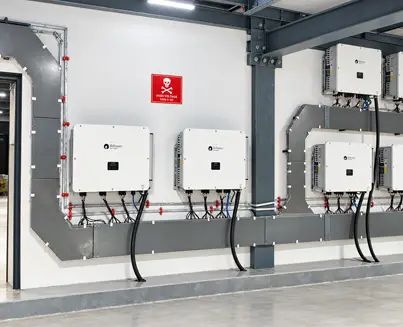
Somaya Solar Solutions Limited designs, supplies and installs battery energy storage systems (BESS) for factories and commercial buildings, for rooftop and ground-mounted solar plants that need storage, and for standalone grid-connected projects. The work is done by the same engineering and site teams that build our industrial rooftop plants and ground-mounted plants, from our base at Ghaziabad, Uttar Pradesh.
This page explains what a BESS is, where it pays in India under the current tariff and policy rules, how a system is sized, what our EPC scope covers, and what we need from you for a quotation. Every figure has a source, listed at the end.
What a Battery Energy Storage System Is
A battery energy storage system is a set of battery modules with a battery management system (BMS), a power conversion system (PCS, the bidirectional inverter that charges and discharges the batteries), an energy management system (EMS) that decides when to charge and discharge, thermal management, and fire detection and suppression. The equipment is housed in an outdoor container or an indoor battery room and connected to the site's switchboard or to the grid through a transformer.
A BESS has two ratings. Power, in kW or MW, is how fast it can deliver or absorb electricity. Energy, in kWh or MWh, is how much it can store. A 1 MW / 2 MWh system delivers 1 MW for two hours; a 250 kW / 500 kWh system delivers 250 kW for two hours. The ratio of energy to power is the discharge duration, and two-hour and four-hour systems are the common sizes in India today.
Lithium iron phosphate (LFP) cells are the usual choice for stationary storage: they tolerate daily cycling, run cooler than other lithium chemistries, and are what the Indian grid-scale tenders are being built with.
Where a BESS Pays in India
1. Time-of-day tariffs for factories and commercial buildings
Under the Electricity (Rights of Consumers) Amendment Rules, 2023, every commercial and industrial consumer with a maximum demand above 10 kW is on a time-of-day (ToD) tariff from 1 April 2024. The rules set the peak-hour tariff for commercial and industrial consumers at not less than 1.2 times the normal tariff, and the solar-hours tariff at 10 to 20 per cent below the normal tariff, with the hours fixed by each state commission. A BESS charges in the cheap solar hours, from the grid or from the site's own solar plant, and discharges in the peak hours. The saving is the gap between the two rates, multiplied by the energy shifted every day.
2. Peak demand and contract demand
Industrial bills carry a demand charge on the contracted or recorded maximum demand. A BESS set to discharge whenever site demand approaches a limit keeps the recorded maximum below that limit, which cuts the demand charge and can avoid a load enhancement when a new line or machine is added.
3. Diesel generator replacement
Where a DG set covers outages, a BESS supplies the short interruptions and the first minutes of a long one, so the DG runs only when an outage lasts. Battery power also costs a fraction of diesel power per kWh, and the plant stays on a clean supply during the switch-over.
4. Using more of your own solar
A rooftop plant produces most between 10 am and 3 pm. A factory that runs two or three shifts, or a building whose evening load is high, exports that midday surplus at a low rate, or loses it where export is capped. Storage moves the surplus to the evening, where it replaces grid power at the peak rate. We size the battery from the plant's generation profile and the site's load curve, not from a rule of thumb.
5. Grid-scale storage
Standalone BESS projects are now a central part of India's power procurement. In June 2025 the Ministry of Power approved a second tranche of viability gap funding (VGF) of Rs 5,400 crore for 30 GWh of standalone BESS, at Rs 18 lakh per MWh, with 25 GWh allotted across 15 states and 5 GWh to NTPC. Tariffs discovered in 2025 standalone tenders fell to about Rs 1.48 lakh per MW per month for two-hour systems. India had about 9.3 GWh of battery storage installed by June 2026, after adding 8.2 GWh in the first half of the year. We build the civil works, structures, DC and AC installation and commissioning of such plants as the EPC contractor for a developer or a DISCOM.
Sizing a BESS: a Worked Example
Take a factory with a 1,000 kW contract demand that wants to shave 200 kW through a four-hour evening peak. The energy to shift is 200 kW multiplied by 4 hours, which is 800 kWh of usable energy a day. With LFP cells kept to a 90 per cent depth of discharge and round-trip losses of about 10 to 15 per cent, that needs a nameplate of about 1,000 kWh and a PCS of 250 kW, so a 250 kW / 1,000 kWh system. If the same factory also runs a 1 MW rooftop plant, part of the charging comes from the plant's midday surplus and the rest from the grid in solar hours.
The real sizing uses twelve months of bills and fifteen-minute meter data, the DISCOM's ToD slots, the DG run-hours and the solar plant's generation, and it produces a payback for two or three candidate sizes. We do this study before any quotation.
What Our BESS EPC Scope Covers
- Study: load analysis from meter data, tariff review, DG and solar data, sizing options and payback.
- Engineering: single-line diagram, protection and earthing, battery room or container layout, cable sizing, fire-protection design, DISCOM and CEA documentation.
- Supply: LFP battery racks or containerised units, PCS, EMS and BMS integration, transformer and switchgear, metering, fire detection and suppression.
- Civil and structure: foundations, plinths, cable trenches and the steel structures, made in our own hot-dip galvanised structure works at Ghaziabad.
- Installation, testing and commissioning: by our own site teams, with the DISCOM inspection and the grid connection.
- Operation and maintenance: monitoring, EMS tuning as tariffs change, thermal and fire system checks, and capacity augmentation when the warranty allows it.
Storage is added to a solar plant we build, to an existing plant built by others, or installed on its own. For a new plant, the solar and storage are engineered together, so the inverter, the structures and the switchgear are sized once.
Battery Backup with Rooftop Solar for Homes and Shops
For a house or a shop, a hybrid rooftop solar system pairs the solar array with a hybrid inverter and an LFP battery, so the lights, fans, the refrigerator and the Wi-Fi run through an outage and the evening load runs on stored solar. The PM Surya Ghar subsidy is calculated on the solar capacity and does not cover the battery; whether a hybrid system qualifies for net metering and the subsidy depends on the DISCOM's rules for your city, which we check before quoting. Our home solar pages cover the subsidy and the net-metering steps.
Rules, Taxes and Safety for BESS in India (2026)
| Item | Position |
|---|---|
| Time-of-day tariff | Mandatory for commercial and industrial consumers above 10 kW from 1 April 2024; peak rate at least 1.2 times normal for them; solar-hours rate 10 to 20 per cent below normal. State commissions fix the hours. |
| GST | 18 per cent on batteries (HSN 8507), against 5 per cent on solar modules and cells since 22 September 2025. Industry bodies are asking for 5 per cent on containerised BESS. |
| Customs duty | Concessional basic customs duty of 10 per cent on stationary, grid-scale and industrial lithium-ion BESS, as clarified by the Ministry of Finance. |
| Safety regulations | CEA (Measures relating to Safety and Electric Supply) Amendment Regulations, 2026, notified 27 March 2026: definitions for BMS and PCS, two-fault tolerance, and independent fire-safety audits of BESS from April 2027. |
| Viability gap funding | Second tranche of June 2025: Rs 5,400 crore for 30 GWh of standalone BESS at Rs 18 lakh per MWh, awarded through tariff-based bidding by the states and NTPC. |
| Installed base | About 9.3 GWh installed in India by June 2026; 28.7 GWh under construction as of 31 January 2026. |
What Decides the Cost of a BESS
The energy capacity in kWh is the largest part of the price, followed by the PCS rating in kW, the chemistry and cell supplier, whether the system is containerised or built in a room, the fire-protection system, the transformer and switchgear, the civil works, and the length and terms of the performance warranty, including capacity augmentation. Battery prices fell sharply through 2025, which is why discovered tariffs halved. We do not publish a price per kWh, because two systems of the same size can differ in all of these; we quote on a single-line diagram and a bill of materials, so two quotations can be compared line by line.
Frequently Asked Questions
What is a battery energy storage system?
A battery energy storage system is a set of battery modules, a battery management system, a power conversion system and an energy management system, with cooling and fire protection, that stores electricity and returns it when it is needed. It is rated by power in kW and energy in kWh.
What is the difference between kW and kWh in a BESS?
kW is the rate at which the system can deliver power; kWh is the amount of energy it stores. Dividing kWh by kW gives the hours of discharge at full power: a 500 kWh battery with a 250 kW inverter runs for two hours.
Which battery is used in a BESS in India?
Lithium iron phosphate (LFP) is the usual chemistry for stationary storage, because it handles daily cycling, runs cooler than other lithium chemistries and is what the current grid-scale projects use.
Does a BESS need a solar plant?
No. A standalone BESS charges from the grid in cheap hours and discharges in peak hours. Pairing it with a solar plant lowers the charging cost further and lets the site use its own midday surplus in the evening.
Is there a subsidy for battery storage in India?
For grid-scale projects, the Ministry of Power's viability gap funding scheme supports standalone BESS at Rs 18 lakh per MWh under the June 2025 tranche. For factories and homes there is no central capital subsidy on the battery; the return comes from the time-of-day tariff gap, lower demand charges and less diesel. The PM Surya Ghar subsidy applies to the solar part of a home system, not to the battery.
What approvals does a BESS need?
A grid-connected system needs the DISCOM's connection approval and inspection, and must meet the CEA safety regulations, which from 2026 include BESS-specific requirements and, from April 2027, independent fire-safety audits. Fire department norms for the building or site apply as well. We prepare and file these documents as part of the EPC scope.
How long does a BESS last?
LFP systems are specified in cycles and years, commonly thousands of full cycles over ten or more years, with a guaranteed capacity at the end of the term. One full cycle a day for the ToD arbitrage fits inside that. The warranty terms, and whether capacity is augmented during the term, are part of the quotation.
What We Need for a BESS Quotation
- twelve months of electricity bills, and fifteen-minute meter data if the DISCOM provides it
- tariff category, contract demand and the ToD slots that apply
- DG set rating, fuel use and run-hours, where there is one
- details of any existing or planned solar plant: capacity, inverter make and generation data
- what the storage is for: peak shaving, backup, solar shifting or a grid project
- site location, the space available indoors or outdoors, and photographs.
With this, we return a sizing study with two or three options, a single-line diagram, a bill of materials and a price.
Sources
- Ministry of Power, Electricity (Rights of Consumers) Amendment Rules, 2023: press release on time-of-day tariffs
- Ministry of Power, second tranche of VGF for 30 GWh of BESS, June 2025: pv magazine India
- Standalone BESS tariffs discovered in 2025: IEEFA, May 2026
- Installed battery storage in India, first half of 2026: Mercom India
- GST on renewable energy devices from 22 September 2025 and on batteries: PV Tech; Energetica India
- Customs duty on lithium-ion BESS: Mercom India
- CEA safety regulations for BESS, 2026: Energetica India; Central Electricity Authority