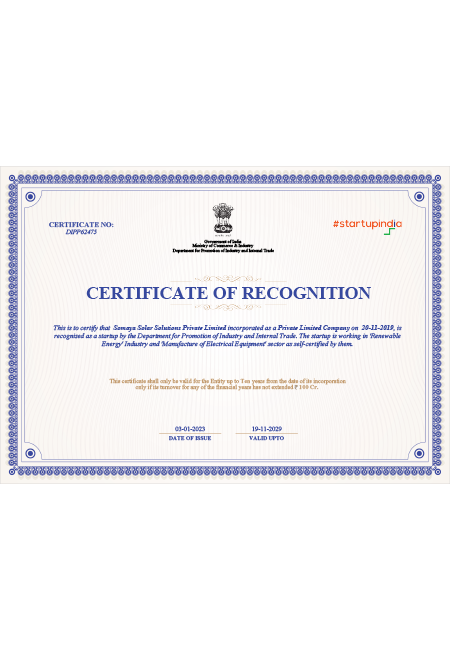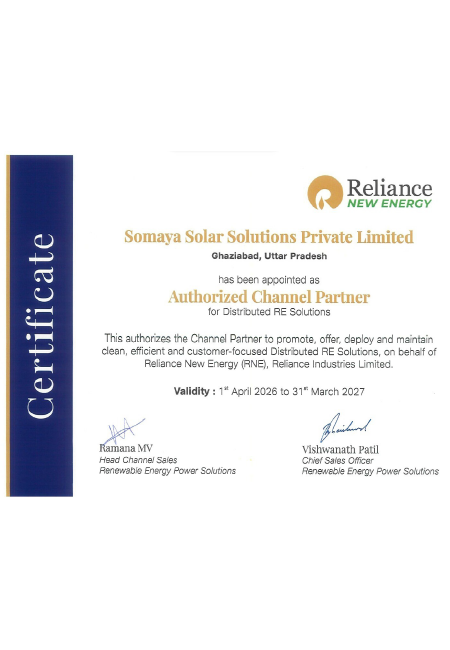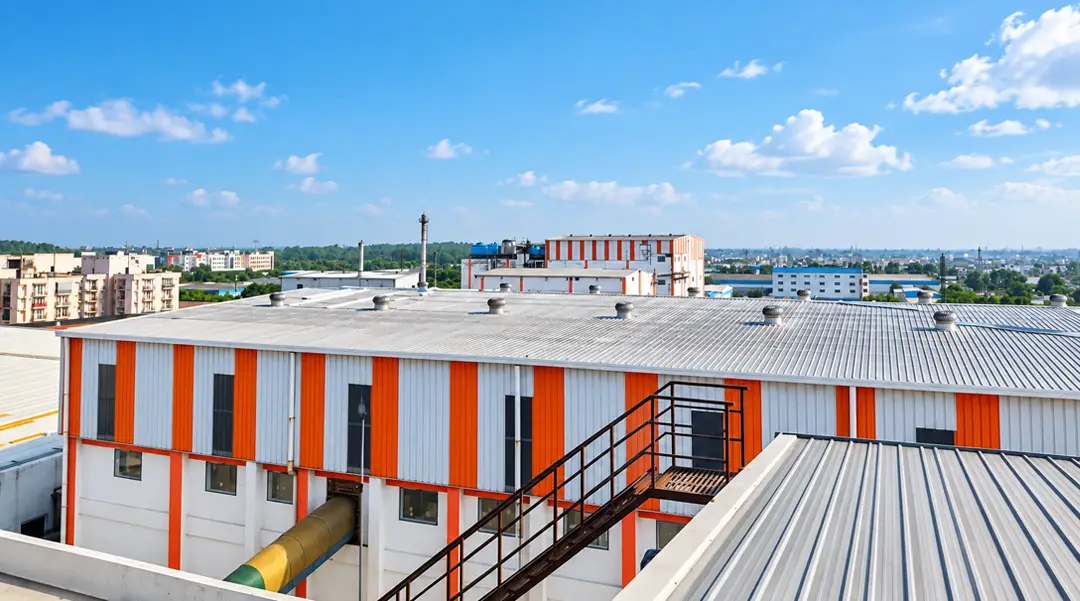
Somaya Solar Solutions Limited, a Ghaziabad-based solar company, installs rooftop solar systems in Chandigarh: for houses under PM Surya Ghar, and for shops, offices, schools, hospitals and factories. One team does the survey, supply, installation, metering and handover.
Somaya Solar as your installer in Chandigarh
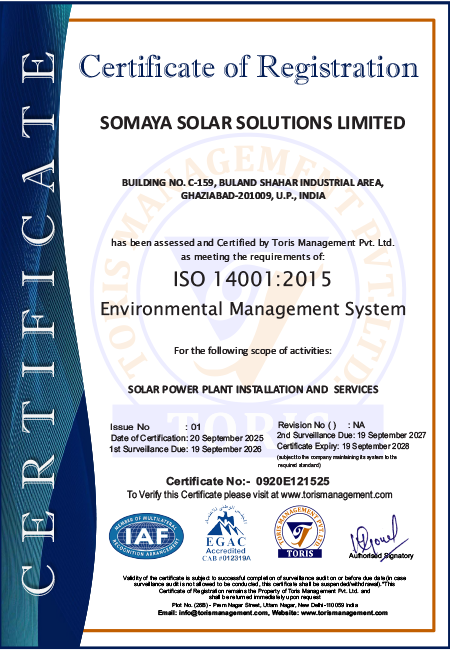
Somaya Solar Solutions Limited is based in Ghaziabad, Uttar Pradesh, about 240 km from Chandigarh in a straight line. The company states on its site over 50 MW installed, 1,500+ customers, 7+ years of work and presence in 6+ states, and holds ISO 9001:2015, ISO 14001:2015 and ISO 45001:2018 certificates. See certifications and projects.
| Based in | Ghaziabad, Uttar Pradesh (C-159, Bulandshahr Road Industrial Area) |
|---|---|
| Installed | 50+ MW cumulative: rooftop and ground-mounted plants from house systems to multi-MW |
| Customers | 1,500+ |
| Experience | 7+ years; presence in 6+ states |
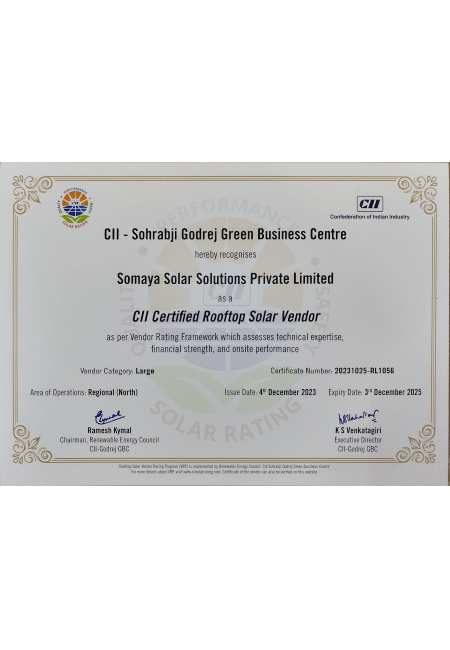
| Certifications | ISO 9001:2015, ISO 14001:2015, ISO 45001:2018; CII certified rooftop solar vendor |
| Structures | Hot-dip galvanised mounting structures made in our own works |
| Service | Monitoring, cleaning and maintenance contracts after handover |
| Vendor registration | Somaya Solar Solutions Limited is on UPNEDA's list of approved firms for rooftop solar in Uttar Pradesh (vendor code GZB2211050152, Ghaziabad, registered 9 November 2022). |
| Distance to Chandigarh | about 240 km in a straight line from our Ghaziabad works |
- Site survey and a written proposal that names the module, inverter and structure
- Grid-connected (on-grid) rooftop systems for houses, housing societies, shops, offices, schools, hospitals and factories
- Subsidy application and net metering paperwork handled with you
- Installation by our own teams on our own hot-dip galvanised structures
- Service and cleaning contracts after handover
How we install a rooftop solar system
A rooftop installation runs in the same order whether it is a 3 kW house system or a 500 kW factory roof; what changes is the paperwork and the structure.
- Site survey: roof type, shadow-free area, structural condition and the route for cables
- Study of twelve months of bills, to size the plant against your use and your sanctioned load
- Design and a fixed-price proposal that names the module, inverter and structure
- Application to the electricity supplier for connection and metering (on the National Portal for a subsidised house system)
- Supply, mounting, wiring, earthing and lightning protection
- Testing, meter installation and commissioning, then handover with warranties and monitoring access
Chandigarh at a glance for solar projects
| Electricity distribution | CPDL (The whole of the Union Territory of Chandigarh) |
|---|---|
| Electricity regulator | Joint Electricity Regulatory Commission for the State of Goa and Union Territories (JERC) |
| Renewable energy agency | Chandigarh Renewable Energy and Science & Technology Promotion Society (CREST) |
| Solar policy | Model Solar City programme of the Chandigarh Administration, run through CREST |
| Rooftop metering for businesses | Net metering up to 500 kWp, within the sanctioned load |
| Modelled solar output | about 1,390 units (kWh) a year for each kW installed |
| Somaya Solar office | Ghaziabad, Uttar Pradesh, about 240 km from Chandigarh in a straight line |
Net metering for a house in Chandigarh
A subsidised home system is grid-connected under net metering: the net metering agreement is part of the application on the National Portal, a bidirectional meter records what the house draws from the grid and what the roof sends back, and the bill is settled on the difference under the state regulator's rules.
Metering for shops, offices and factories in Chandigarh
In Chandigarh, a consumer can connect a rooftop, ground-mounted or floating solar plant of up to 500 kWp at one premises under JERC's net metering regulations of 2019, as amended in 2024. A plant above 500 kWp comes under net billing (net feed-in). The plant may not be larger than the consumer's contract demand or sanctioned load. The plant may be owned by the consumer or by a third party.
- Under net billing, power drawn from the grid is charged at the retail tariff and solar power sent to the grid is valued at the feed-in tariff set by the Commission.
- Gross metering is allowed for a consumer or generator who chooses to sell all the solar power to the distribution licensee at the feed-in tariff set by the Commission.
- The total solar capacity connected to one distribution transformer may not exceed 75% of that transformer's capacity. The licensee may allow more after a detailed load study.
- Under net metering, surplus units carry forward to the next billing period. Units still unadjusted at the end of the financial year are bought by the licensee at its average power purchase cost or the feed-in tariff, whichever is lower.
- Group net metering is open to all consumers. Virtual net metering is for residential consumers, group housing societies and establishments of government or local authorities. Under both, the plant may be up to 500 kWp or the sanctioned load, whichever is lower.
- A consumer may lease the roof or land to a solar developer under net metering. Plants under these regulations are exempt from open access charges and from banking charges.
- For a rooftop plant the licensee must finish the technical feasibility study within fifteen days. If it does not, the proposal is taken to be technically feasible. An application for a plant up to 10 kW is deemed accepted without the study.
- Latest amendment: the First Amendment Regulations, 2024, notified on 1 August 2024 and published in the Gazette of India on 11 September 2024.
What a rooftop system produces in Chandigarh
A solar plant in Chandigarh is modelled to produce about 1,390 units (kWh) a year for each kW installed, for a rooftop array at a 10° tilt.
| Plant size | Modelled output a year | Shadow-free roof needed (typical) |
|---|---|---|
| 3 kW | 4,170 units | 30 sq m |
| 5 kW | 6,950 units | 50 sq m |
| 10 kW | 13,900 units | 100 sq m |
| 100 kW | 1.4 lakh units | 1,000 sq m |
Output figures are modelled with the European Commission's PVGIS tool (ERA5 weather data, 2005 to 2023) with system losses set at 20%, which is on the cautious side. Real output depends on shading, dust, equipment and layout. A site study gives the figure to plan on.
Chandigarh: a city that builds its solar on rooftops
The Chandigarh Administration states that the union territory has no power generating unit of its own and takes its power from neighbouring states. Because land is scarce in the city, the Administration plans its solar capacity as rooftop plants. The Ministry of New and Renewable Energy selected Chandigarh to be developed as a Model Solar City, and a Solar City cell works in CREST.
Electricity distribution in Chandigarh passed from the Electricity Wing of the Engineering Department to Chandigarh Power Distribution Limited (CPDL) on 1 February 2025. CPDL is the distribution licensee for the whole union territory, so a net metering application for a plant in Chandigarh is made to CPDL.
Subsidy for houses in Chandigarh
Under PM Surya Ghar: Muft Bijli Yojana the central government pays ₹30,000 for a 1 kW system, ₹60,000 for 2 kW and ₹78,000 for 3 kW or larger. The full table, the conditions and the application steps are on Solar subsidy in Chandigarh.
Rooftop installations by Somaya Solar near Chandigarh
These are the Somaya Solar projects closest to Chandigarh, with straight-line distances. They are shown as references and are not in Chandigarh unless the line says so.
- Akums Limited: 2.3 MW rooftop plant, SIDCUL, Haridwar, Uttarakhand, about 150 km from Chandigarh. In progress. The roof is more than 70 feet above the ground, so material is lifted by several cranes.
- Luminous: 1 MW rooftop plant, Haridwar, Uttarakhand, about 160 km from Chandigarh. Included net-metering coordination with the local electricity distribution company.
- Naini Papers Limited: 3 MW rooftop plant, Kashipur, Uttarakhand, about 270 km from Chandigarh. Completed in two months, with five years of operation and maintenance.
Questions about solar projects in Chandigarh
Is net metering available for factories and commercial buildings in Chandigarh?
In Chandigarh, a consumer can connect a rooftop, ground-mounted or floating solar plant of up to 500 kWp at one premises under JERC's net metering regulations of 2019, as amended in 2024. A plant above 500 kWp comes under net billing (net feed-in). The plant may not be larger than the consumer's contract demand or sanctioned load. The plant may be owned by the consumer or by a third party.
How much solar subsidy can a house in Chandigarh get?
The central subsidy under PM Surya Ghar is ₹30,000 for a 1 kW system, ₹60,000 for 2 kW and ₹78,000 for 3 kW or larger.
How much roof does a home solar system need in Chandigarh?
About 10 sq m of shadow-free roof for each kW: a 3 kW system needs about 30 sq m (roughly 320 sq ft). Sheet and concrete roofs both work; the structure is designed for the roof.
How many units will a 3 kW system generate in Chandigarh?
About 4,170 units a year, or about 348 a month on average, by the PVGIS model for Chandigarh. Summer months give more, the monsoon less.
Does Somaya Solar handle the subsidy application and net metering?
Yes. The application on the National Portal, the vendor details, the net metering agreement and the commissioning report are done with you; the subsidy is paid by the government into your bank account.
How long does a rooftop solar installation take in Chandigarh?
The work on the roof is usually a matter of days. The time before it goes on the survey, the proposal and the supplier's approval; the time after it on the meter and the commissioning inspection. The proposal carries a dated schedule.
How much electricity does a solar plant generate in Chandigarh?
About 1,390 units (kWh) a year for each kW installed, by the PVGIS model with cautious loss settings. A 1 MW plant works out to about 13.9 lakh units a year. A site study gives the figure to plan on.
Where is Somaya Solar based, and how far is that from Chandigarh?
Somaya Solar Solutions Limited works from C-159, Bulandshahr Road Industrial Area, Ghaziabad, Uttar Pradesh, about 240 km from Chandigarh in a straight line. The closest published project is Akums Limited (2.3 MW rooftop plant) in SIDCUL, Haridwar, about 150 km away.
What does Somaya Solar need to prepare a proposal?
Twelve months of electricity bills, the sanctioned load or contract demand, the roof or land details with photographs, and the plant size you have in mind if you have one.
Discuss a solar project in Chandigarh
Send your electricity bills, sanctioned load and roof or land details, and we will reply with a first assessment.
Email: info@somayasolar.com
Phone: +91-8700035846
Sources
Local rules and figures on this page were last checked on 25 November 2026. Rules and tariffs change; confirm the current position before you commit to a project.
- Chandigarh Administration, Department of Science & Technology & Renewable Energy (web page, read 17 November 2026)
- Chandigarh Administration, Department of Science & Technology & Renewable Energy (web page, read 17 November 2026); Lok Sabha Unstarred Question 2920, answered 5 August 2026
- GeoNames (place coordinates, CC BY 4.0)
- Government of NCT of Delhi, Energy Efficiency and Renewable Energy Management Centre: PM Surya Ghar central subsidy (page updated 25 November 2026)
- JERC (Solar PV Grid Interactive System based on Net Metering) Regulations, 2019 (No. JERC-24/2019, notified 24 July 2019) and the Net Metering & Gross Metering (First Amendment) Regulations, 2024 (notified 1 August 2024, Gazette of India 11 September 2024)
- JERC (Specific Conditions of Distribution License applicable to Chandigarh Power Distribution Limited) Regulations, 2026, Gazette of India, 24 October 2026, and JERC Tariff Order of 30 October 2025 (CPDL took over from the Electricity Wing of the Engineering Department on 1 February 2025)
- JERC Tariff Order for Chandigarh Power Distribution Limited, Petition No. 150/2025, dated 30 October 2025
- JERC Tariff Order for Chandigarh Power Distribution Limited, Petition No. 150/2025, dated 30 October 2025 (section 1.1)
- PVGIS, European Commission Joint Research Centre (solar output model)
- Press Information Bureau: PM Surya Ghar reaches 23.96 lakh households, written reply in Rajya Sabha (8 December 2025)
- UPNEDA Solar Rooftop Portal: Approved Firms
- UPNEDA Solar Rooftop Portal: FAQ