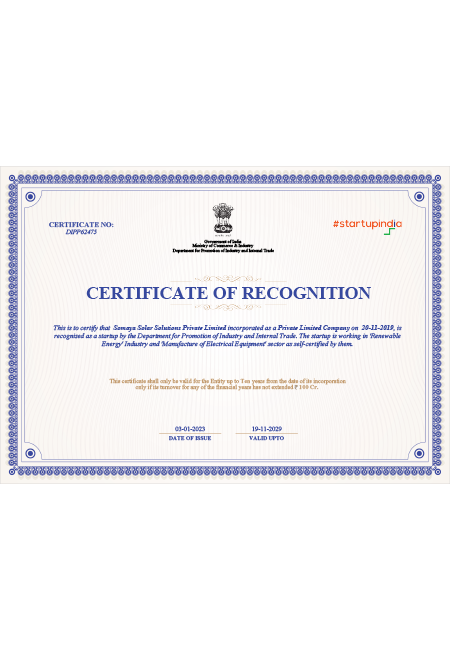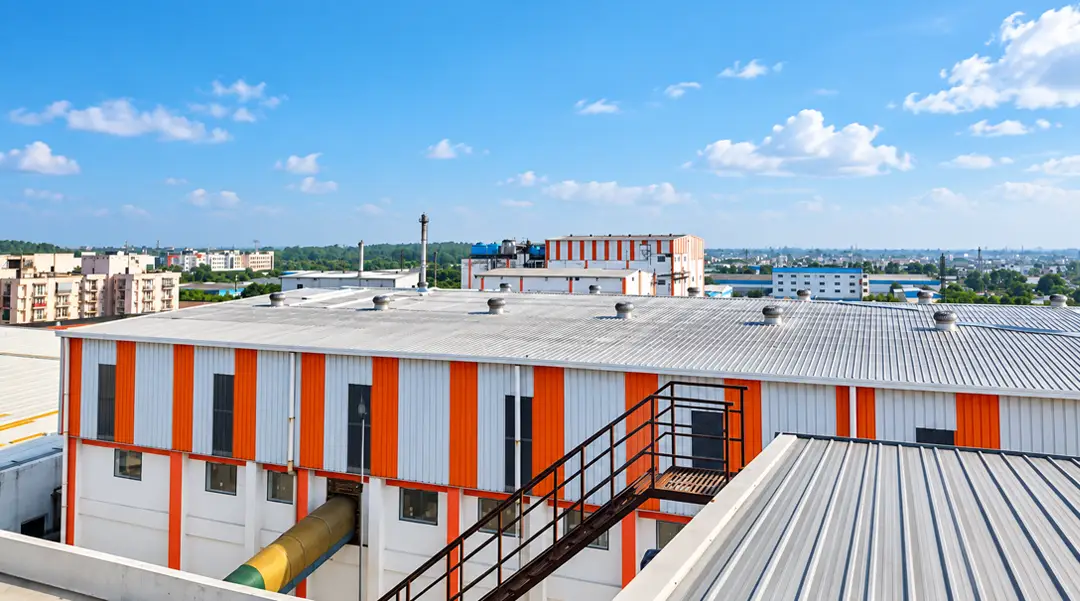
Somaya Solar Solutions Limited, a Ghaziabad-based solar company, installs rooftop solar systems in Tamil Nadu: for houses under PM Surya Ghar, and for shops, offices, schools, hospitals and factories. One team does the survey, supply, installation, metering and handover.
Somaya Solar as your installer in Tamil Nadu
Somaya Solar Solutions Limited is based in Ghaziabad, Uttar Pradesh. The company states on its site over 50 MW installed, 1,500+ customers, 7+ years of work and presence in 6+ states, and holds ISO 9001:2015, ISO 14001:2015 and ISO 45001:2018 certificates. See certifications and projects.
| Based in | Ghaziabad, Uttar Pradesh (C-159, Bulandshahr Road Industrial Area) |
|---|---|
| Installed | 50+ MW cumulative: rooftop and ground-mounted plants from house systems to multi-MW |
| Customers | 1,500+ |
| Experience | 7+ years; presence in 6+ states |
| Certifications | ISO 9001:2015, ISO 14001:2015, ISO 45001:2018; CII certified rooftop solar vendor |
| Structures | Hot-dip galvanised mounting structures made in our own works |
| Service | Monitoring, cleaning and maintenance contracts after handover |
| Vendor registration | Somaya Solar Solutions Limited is on UPNEDA's list of approved firms for rooftop solar in Uttar Pradesh (vendor code GZB2211050152, Ghaziabad, registered 9 November 2022). |
- Site survey and a written proposal that names the module, inverter and structure
- Grid-connected (on-grid) rooftop systems for houses, housing societies, shops, offices, schools, hospitals and factories
- Subsidy application and net metering paperwork handled with you
- Installation by our own teams on our own hot-dip galvanised structures
- Service and cleaning contracts after handover
How we install a rooftop solar system
A rooftop installation runs in the same order whether it is a 3 kW house system or a 500 kW factory roof; what changes is the paperwork and the structure.
- Site survey: roof type, shadow-free area, structural condition and the route for cables
- Study of twelve months of bills, to size the plant against your use and your sanctioned load
- Design and a fixed-price proposal that names the module, inverter and structure
- Application to the electricity supplier for connection and metering (on the National Portal for a subsidised house system)
- Supply, mounting, wiring, earthing and lightning protection
- Testing, meter installation and commissioning, then handover with warranties and monitoring access
Tamil Nadu at a glance for solar projects
| Electricity regulator | Tamil Nadu Electricity Regulatory Commission (TNERC) |
|---|---|
| State renewable energy agency | Tamil Nadu Energy Development Agency (TEDA) |
| Electricity distribution | TNPDCL (The whole state of Tamil Nadu. TNPDCL is the former TANGEDCO and was renamed on 27 June 2024.) |
| State solar policy | Tamil Nadu Solar Energy Policy 2019: still cited by the utility, current status not confirmed |
| Rooftop metering for businesses | Net metering for homes only; commercial and industrial users get net billing (net feed-in) up to the sanctioned load or 999 kW |
Net metering for a house in Tamil Nadu
A subsidised home system is grid-connected under net metering: the net metering agreement is part of the application on the National Portal, a bidirectional meter records what the house draws from the grid and what the roof sends back, and the bill is settled on the difference under the state regulator's rules.
Metering for shops, offices and factories in Tamil Nadu
In Tamil Nadu, net metering is open only to domestic consumers. Commercial and industrial consumers, at any voltage, can install rooftop solar under net billing (also called net feed-in) up to their sanctioned load or contract demand, or 999 kW, whichever is lower. The rules are in the TNERC Grid Interactive Solar PV Energy Generating Systems Regulations, 2021, which apply to loads of less than 1 MW.
- Under net billing, imports are billed at the retail tariff and exports are credited at the feed-in tariff fixed by TNERC. A surplus credit carries over to the next billing cycle. At the end of the settlement period on 31 March the consumer can take payment for the net credit or carry it over.
- Gross metering is open to consumers other than domestic and to generators, for systems of 151 kW to 999 kW. The whole output is sold to the distribution company at the feed-in tariff, through a separate line to the nearest HT network. Low-tension consumers are not eligible for gross metering.
- The levelised feed-in tariffs in the generic tariff order of 22 October 2021 are ₹3.61 per kWh for 1 to 10 kW, ₹3.37 per kWh for 11 to 150 kW and ₹3.10 per kWh for 151 to 999 kW.
- The plant may not be larger than the sanctioned load or contract demand. The solar systems under net metering or net billing connected to one distribution transformer together may not exceed 90% of that transformer's capacity.
- Network charges apply to the total units generated under net billing. TNPDCL's rooftop solar page shows ₹1.04 per kWh for consumers above 150 kW and ₹1.60 per kWh for other low-tension consumers. Gross metering pays no network charge.
- TNPDCL's rooftop solar page says that for HT consumers above 1 MW, approvals are given to run the plant in parallel with the grid, with reverse power relays.
- No rule on group or virtual net metering was found in the regulations. A draft of new Grid Interactive Solar PV regulations was published for comments in June 2024. The TNERC list of final regulations shows only the 2021 regulations.
What a rooftop system produces in Tamil Nadu
Solar output changes across Tamil Nadu with latitude, haze and temperature. The table shows modelled yearly output for each kW installed, for a low-tilt rooftop array and for a ground-mounted array at the best fixed tilt. Across these places the figure runs from about 1,330 to 1,500 units per kW.
| Place | Rooftop, 10° tilt (kWh per kW a year) | Ground-mounted, best fixed tilt (kWh per kW a year) |
|---|---|---|
| Ambattur | 1,360 | 1,360 |
| Avadi | 1,360 | 1,360 |
| Chennai | 1,390 | 1,390 |
| Coimbatore | 1,360 | 1,360 |
| Dindigul | 1,340 | 1,350 |
| Erode | 1,370 | 1,370 |
| Hosur | 1,410 | 1,410 |
| Kallakurichi | 1,330 | 1,340 |
| Kanchipuram | 1,350 | 1,350 |
| Karur | 1,390 | 1,390 |
| Madurai | 1,330 | 1,340 |
| Nagercoil | 1,500 | 1,500 |
| Ooty | 1,390 | 1,400 |
| Ranipet | 1,340 | 1,340 |
| Salem | 1,370 | 1,380 |
| Sivakasi | 1,370 | 1,370 |
| Thanjavur | 1,330 | 1,330 |
| Thoothukudi | 1,470 | 1,470 |
| Tiruchirappalli | 1,350 | 1,360 |
| Tirunelveli | 1,410 | 1,410 |
| Tiruppur | 1,390 | 1,390 |
| Vellore | 1,340 | 1,350 |
Output figures are modelled with the European Commission's PVGIS tool (ERA5 weather data, 2005 to 2023) with system losses set at 20%, which is on the cautious side. Real output depends on shading, dust, equipment and layout. A site study gives the figure to plan on.
Subsidy for houses in Tamil Nadu
Under PM Surya Ghar: Muft Bijli Yojana the central government pays ₹30,000 for a 1 kW system, ₹60,000 for 2 kW and ₹78,000 for 3 kW or larger. The full table, the conditions and the application steps are on Solar subsidy in Tamil Nadu.
Questions about solar projects in Tamil Nadu
Is net metering available for factories and commercial buildings in Tamil Nadu?
In Tamil Nadu, net metering is open only to domestic consumers. Commercial and industrial consumers, at any voltage, can install rooftop solar under net billing (also called net feed-in) up to their sanctioned load or contract demand, or 999 kW, whichever is lower. The rules are in the TNERC Grid Interactive Solar PV Energy Generating Systems Regulations, 2021, which apply to loads of less than 1 MW.
How much solar subsidy can a house in Tamil Nadu get?
The central subsidy under PM Surya Ghar is ₹30,000 for a 1 kW system, ₹60,000 for 2 kW and ₹78,000 for 3 kW or larger.
How much roof does a home solar system need in Tamil Nadu?
About 10 sq m of shadow-free roof for each kW: a 3 kW system needs about 30 sq m (roughly 320 sq ft). Sheet and concrete roofs both work; the structure is designed for the roof.
Does Somaya Solar handle the subsidy application and net metering?
Yes. The application on the National Portal, the vendor details, the net metering agreement and the commissioning report are done with you; the subsidy is paid by the government into your bank account.
How long does a rooftop solar installation take in Tamil Nadu?
The work on the roof is usually a matter of days. The time before it goes on the survey, the proposal and the supplier's approval; the time after it on the meter and the commissioning inspection. The proposal carries a dated schedule.
Where is Somaya Solar based?
Somaya Solar Solutions Limited works from C-159, Bulandshahr Road Industrial Area, Ghaziabad, Uttar Pradesh.
What does Somaya Solar need to prepare a proposal?
Twelve months of electricity bills, the sanctioned load or contract demand, the roof or land details with photographs, and the plant size you have in mind if you have one.
Discuss a solar project in Tamil Nadu
Send your electricity bills, sanctioned load and roof or land details, and we will reply with a first assessment.
Email: info@somayasolar.com
Phone: +91-8700035846
Sources
Local rules and figures on this page were last checked on 25 November 2026. Rules and tariffs change; confirm the current position before you commit to a project.
- Government of NCT of Delhi, Energy Efficiency and Renewable Energy Management Centre: PM Surya Ghar central subsidy (page updated 25 November 2026)
- PIB, Ministry of New and Renewable Energy, 24 July 2024 (names TEDA as the agency solarising Government buildings in Tamil Nadu)
- PVGIS, European Commission Joint Research Centre (solar output model)
- Press Information Bureau: PM Surya Ghar reaches 23.96 lakh households, written reply in Rajya Sabha (8 December 2025)
- TNERC (Grid Interactive Solar PV Energy Generating Systems) Regulations, 2021, notified 7 October 2021 (Tamil Nadu Government Gazette, 20 October 2021); TANGEDCO salient features of TNERC generic tariff order No. 8 of 2021 dated 22 October 2021; TNPDCL rooftop solar page 'Policies Adopted'
- TNERC suo-motu tariff order No. 6 of 2025, dated 30 June 2025 (TNPDCL, FY 2025-26, effective 1 July 2025) (paragraphs 1.1.10 and 1.1.11); TNPDCL profile page (tnpdcl.org)
- Tamil Nadu Unified Solar Rooftop Portal FAQ (TANGEDCO/TNGECL); TNGECL Policies page; TNERC order of 19 Feb 2026
- Tamilnadu Electricity Regulatory Commission
- UPNEDA Solar Rooftop Portal: Approved Firms
- UPNEDA Solar Rooftop Portal: FAQ