Somaya Solar Solutions Limited, a Ghaziabad-based solar company, installs rooftop solar systems in Kerala: for houses under PM Surya Ghar, and for shops, offices, schools, hospitals and factories. One team does the survey, supply, installation, metering and handover.
Somaya Solar as your installer in Kerala
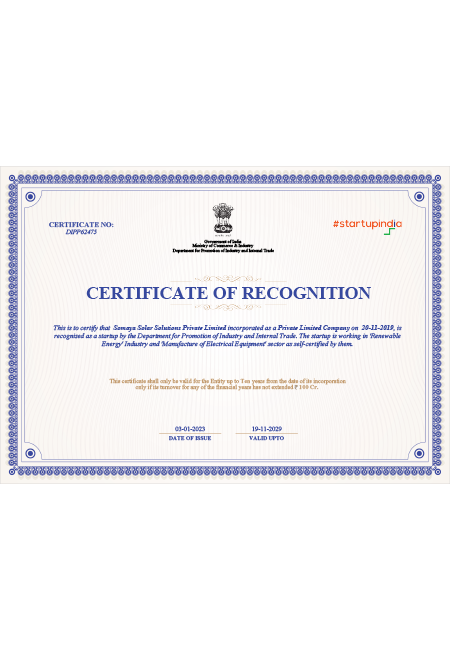
Somaya Solar Solutions Limited is based in Ghaziabad, Uttar Pradesh. The company states on its site over 50 MW installed, 1,500+ customers, 7+ years of work and presence in 6+ states, and holds ISO 9001:2015, ISO 14001:2015 and ISO 45001:2018 certificates. See certifications and projects.
| Based in | Ghaziabad, Uttar Pradesh (C-159, Bulandshahr Road Industrial Area) |
|---|---|
| Installed | 50+ MW cumulative: rooftop and ground-mounted plants from house systems to multi-MW |
| Customers | 1,500+ |
| Experience | 7+ years; presence in 6+ states |
| Certifications | ISO 9001:2015, ISO 14001:2015, ISO 45001:2018; CII certified rooftop solar vendor |
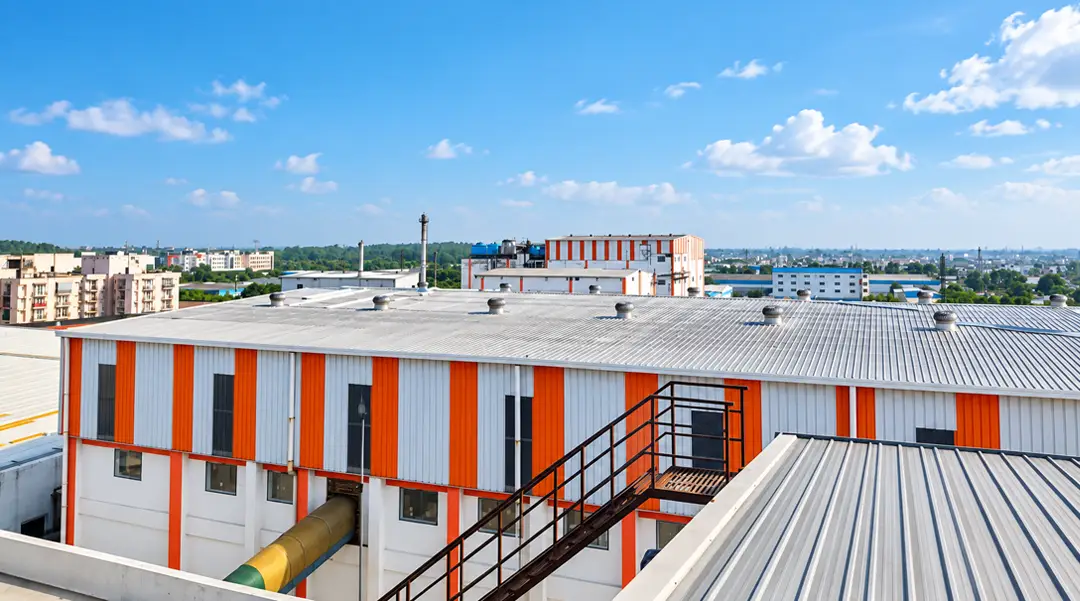
| Structures | Hot-dip galvanised mounting structures made in our own works |
| Service | Monitoring, cleaning and maintenance contracts after handover |
| Vendor registration | Somaya Solar Solutions Limited is on UPNEDA's list of approved firms for rooftop solar in Uttar Pradesh (vendor code GZB2211050152, Ghaziabad, registered 9 November 2022). |
- Site survey and a written proposal that names the module, inverter and structure
- Grid-connected (on-grid) rooftop systems for houses, housing societies, shops, offices, schools, hospitals and factories
- Subsidy application and net metering paperwork handled with you
- Installation by our own teams on our own hot-dip galvanised structures
- Service and cleaning contracts after handover
How we install a rooftop solar system
A rooftop installation runs in the same order whether it is a 3 kW house system or a 500 kW factory roof; what changes is the paperwork and the structure.
- Site survey: roof type, shadow-free area, structural condition and the route for cables
- Study of twelve months of bills, to size the plant against your use and your sanctioned load
- Design and a fixed-price proposal that names the module, inverter and structure
- Application to the electricity supplier for connection and metering (on the National Portal for a subsidised house system)
- Supply, mounting, wiring, earthing and lightning protection
- Testing, meter installation and commissioning, then handover with warranties and monitoring access
Kerala at a glance for solar projects
| Electricity regulator | Kerala State Electricity Regulatory Commission (KSERC) |
|---|---|
| State renewable energy agency | Agency for New and Renewable Energy Research and Technology (ANERT) |
| Electricity distribution | KSEB Ltd (The incumbent licensee for the state, outside the licence areas of the licensees listed below. It supplied about 141 lakh consumers on 31 March 2025. The Commission has left the KINFRA industrial parks at Perumbavoor (Ernakulam) and Puzhakkal (Thrissur) with KSEB Ltd.); TCED (The old Thrissur Municipality area, about 12.65 square km (inside Thrissur city).); Technopark (Technopark Phase I, Technopark Phase II and III, Technocity at Pallippuram and Technopark Kollam.); Infopark (The Infopark campuses at Kakkanad (Kochi) and Cherthala.); CSEZA (The Cochin Special Economic Zone, 105 acres at Kakkanad, Kochi.); KINESCO (Five KINFRA industrial parks: KEPIP Kakkanad, Hi-Tech Park Kalamassery, KIITP Kanjikode, KINFRA Mega Food Park at Kozhipara (Kanjikode, Palakkad) and KINFRA Petrochemical Park at Ambalamugal, Kochi.); CoPA (Willington Island (W Island), Vallarpadam and Puthuvypin in Ernakulam district.); Rubber Park (The industrial park at Valayanchirangara near Perumbavoor, Ernakulam district.); Smart City Kochi (The Smart City information technology special economic zone in Kochi.); KDHPCL (Its licence area at Munnar (tea estates).) |
| State solar policy | Kerala Solar Energy Policy, 2013 (G.O.(P) No. 49/2013/PD of 25 November 2013; stays in force until another policy replaces it) |
| Rooftop metering for businesses | Net metering up to 500 kW for industrial consumers; net billing up to 1 MW (3 MW with storage) |
Net metering for a house in Kerala
A subsidised home system is grid-connected under net metering: the net metering agreement is part of the application on the National Portal, a bidirectional meter records what the house draws from the grid and what the roof sends back, and the bill is settled on the difference under the state regulator's rules.
Metering for shops, offices and factories in Kerala
In Kerala an industrial consumer can install rooftop or other solar of 1 kW to 500 kW under net metering, within the connected load or contract demand. Larger plants go under net billing (up to 1,000 kW, or 3,000 kW with storage) or gross metering (up to 3,000 kW). The rules are in the KSERC (Renewable Energy and Related Matters) Regulations, 2025, notified on 5 November 2025. They replaced the 2020 net metering regulations, and KSERC's list shows no later amendment.
- Industrial net metering plants above 25 kW and up to 100 kW need a hybrid inverter with storage of at least 10% of the plant's energy generation potential. Above 100 kW and up to 500 kW the storage must be at least 20%.
- The plant may not be larger than the connected load in kW or the contract demand in kVA.
- Net billing is open to all consumers up to the lower of the connected load or contract demand and 1,000 kW. With storage of at least 30% of the plant's energy generation potential the limit is 3,000 kW.
- Gross metering is open to all consumers, for plants of 1 kW to 3,000 kW.
- Group net metering lets a consumer use the excess power at another premises of its own in the area of the same licensee. Virtual net metering is for groups such as residential complexes, government offices and MSMEs of up to 10 kW; it is not open to ordinary industrial consumers.
- For new industrial net metering plants above 25 kW, exports are set off against imports zone by zone, and surplus is paid at the feed-in tariff set by the Commission.
- Industrial net metering consumers pay grid support charges on grid power used in non-solar hours, up to the banked energy set off: 50 paise per kWh for the first 300 units and ₹1 per kWh after that, until the Commission fixes the charge in a tariff order.
- Surplus carried forward loses 2% of the balance units a month. Balance at year end is paid at ₹2.79 per kWh for new solar prosumers and at the APPC rate of ₹3.08 per kWh for existing prosumers, as set in the regulations.
- The energy accounting, billing and settlement rules of the 2025 regulations apply from 1 January 2026. Existing net metering prosumers stay under net metering until they change system or increase capacity.
What a rooftop system produces in Kerala
Solar output changes across Kerala with latitude, haze and temperature. The table shows modelled yearly output for each kW installed, for a low-tilt rooftop array and for a ground-mounted array at the best fixed tilt. Across these places the figure runs from about 1,240 to 1,440 units per kW.
| Place | Rooftop, 10° tilt (kWh per kW a year) | Ground-mounted, best fixed tilt (kWh per kW a year) |
|---|---|---|
| Alappuzha | 1,280 | 1,290 |
| Kochi | 1,240 | 1,240 |
| Kollam | 1,400 | 1,400 |
| Kozhikode | 1,250 | 1,260 |
| Thiruvananthapuram | 1,440 | 1,440 |
Output figures are modelled with the European Commission's PVGIS tool (ERA5 weather data, 2005 to 2023) with system losses set at 20%, which is on the cautious side. Real output depends on shading, dust, equipment and layout. A site study gives the figure to plan on.
Subsidy for houses in Kerala
Under PM Surya Ghar: Muft Bijli Yojana the central government pays ₹30,000 for a 1 kW system, ₹60,000 for 2 kW and ₹78,000 for 3 kW or larger. The full table, the conditions and the application steps are on Solar subsidy in Kerala.
Questions about solar projects in Kerala
Is net metering available for factories and commercial buildings in Kerala?
In Kerala an industrial consumer can install rooftop or other solar of 1 kW to 500 kW under net metering, within the connected load or contract demand. Larger plants go under net billing (up to 1,000 kW, or 3,000 kW with storage) or gross metering (up to 3,000 kW). The rules are in the KSERC (Renewable Energy and Related Matters) Regulations, 2025, notified on 5 November 2025. They replaced the 2020 net metering regulations, and KSERC's list shows no later amendment.
How much solar subsidy can a house in Kerala get?
The central subsidy under PM Surya Ghar is ₹30,000 for a 1 kW system, ₹60,000 for 2 kW and ₹78,000 for 3 kW or larger.
How much roof does a home solar system need in Kerala?
About 10 sq m of shadow-free roof for each kW: a 3 kW system needs about 30 sq m (roughly 320 sq ft). Sheet and concrete roofs both work; the structure is designed for the roof.
Does Somaya Solar handle the subsidy application and net metering?
Yes. The application on the National Portal, the vendor details, the net metering agreement and the commissioning report are done with you; the subsidy is paid by the government into your bank account.
How long does a rooftop solar installation take in Kerala?
The work on the roof is usually a matter of days. The time before it goes on the survey, the proposal and the supplier's approval; the time after it on the meter and the commissioning inspection. The proposal carries a dated schedule.
Where is Somaya Solar based?
Somaya Solar Solutions Limited works from C-159, Bulandshahr Road Industrial Area, Ghaziabad, Uttar Pradesh.
What does Somaya Solar need to prepare a proposal?
Twelve months of electricity bills, the sanctioned load or contract demand, the roof or land details with photographs, and the plant size you have in mind if you have one.
Discuss a solar project in Kerala
Send your electricity bills, sanctioned load and roof or land details, and we will reply with a first assessment.
Email: info@somayasolar.com
Phone: +91-8700035846
Sources
Local rules and figures on this page were last checked on 25 November 2026. Rules and tariffs change; confirm the current position before you commit to a project.
- ANERT website, Overview page (the name is in Malayalam script there); Kerala Solar Energy Policy 2013 names ANERT as the nodal agency for non-conventional energy
- Government of NCT of Delhi, Energy Efficiency and Renewable Energy Management Centre: PM Surya Ghar central subsidy (page updated 25 November 2026)
- KSERC (Renewable Energy and Related Matters) Regulations, 2025, notified 5 November 2025
- KSERC (Renewable Energy and Related Matters) Regulations, 2025, notified 5 November 2025 (Gazette 6 November 2025)
- KSERC orders of 2025 and 2026 on KSEB Ltd (OP 63/2025, 21 May 2026) and on the other licensees (OP 62/2025, 61/2025, 59/2025, 08/2026, 58/2025, 02/2026, 15/2026, 10/2026, 60/2025); the tariff schedule of 5 December 2024 is issued for "KSEB Ltd and all other licensees"
- Kerala Solar Energy Policy 2013 (G.O.(P) No. 49/2013/PD, 25 November 2013), as published by ANERT
- PVGIS, European Commission Joint Research Centre (solar output model)
- Press Information Bureau: PM Surya Ghar reaches 23.96 lakh households, written reply in Rajya Sabha (8 December 2025)
- UPNEDA Solar Rooftop Portal: Approved Firms
- UPNEDA Solar Rooftop Portal: FAQ